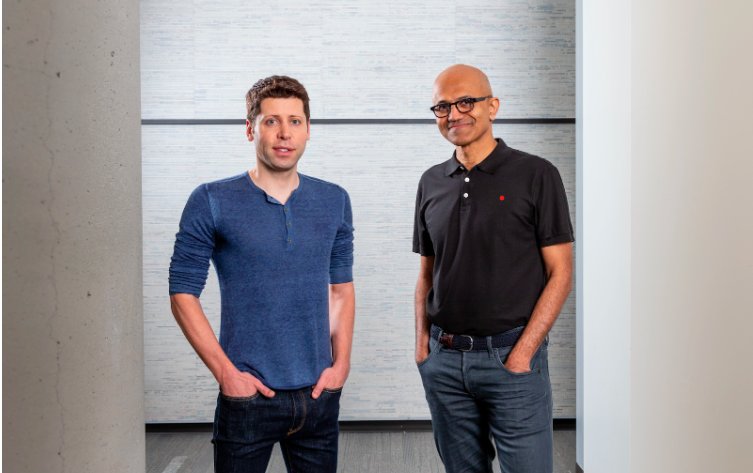
The year is 2019. A hand-pocketed Satya Nadella poses with hand-pocketed Sam Altman after getting their respective babies, Microsoft and OpenAI, into a sort of no-ring-exchanged engagement. Between the technical noise and the AI enthusiasm, the Microsoft press release mentions: "Microsoft will become OpenAI's preferred partner for commercializing new AI technologies."
But since the year is 2019 and AI is still in its infancy for the masses, few heads turned. Later, as per the New York Times, over the next few years, Microsoft quietly invested another $2 billion.
OpenAI releases its much-anticipated AI tool based on generative pre-trained transformer technology — harnessing enormous amounts of data to train and develop a natural language processing chatbot known as ChatGPT.
Right after its release, ChatGPT shattered the records of tech super-apps such as Facebook, Instagram, and TikTok, which took months or even years to reach the one million user mark. ChatGPT gained one million users within five days.
Three months after its release, on January 23, 2023, Microsoft further committed to advanced AI by announcing a multiyear, multibillion dollar investment to "accelerate AI breakthroughs to ensure these benefits are broadly shared with the world."
And in a passing reference — almost incidental in tone — the Microsoft statement reads that Microsoft will be OpenAI's exclusive cloud provider. Further adding: "Azure will power all OpenAI workloads across research, products and API services."
Including the enormous compute required to train such generative AI models. On top of that, since the API services are also in an exclusive partnership with Microsoft Azure, any business that uses GPT-3.5 or beyond to develop any application or machine learning model will have to route through Microsoft Azure.
In effect, Microsoft has created a monopoly on advanced generative AI by mandating the use of Azure for everything-OpenAI.
The contract clause that did it wasn't announced as a monopoly. It was framed as a partnership. Infrastructure-level control, dressed as enthusiasm for shared progress.
Well played, Microsoft.